
Goldspotted Oak Borer & Dead Oak Field Guide: Diagnosis, Beetle Care & Hazard Removal
An arborist guide to diagnosing Goldspotted Oak Borer (GSOB), managing native live oak health, and safely removing dead hazard oaks in East County San Diego.
CSLB D-49 License #1077695 • 40+ Years East County Tree Specialist
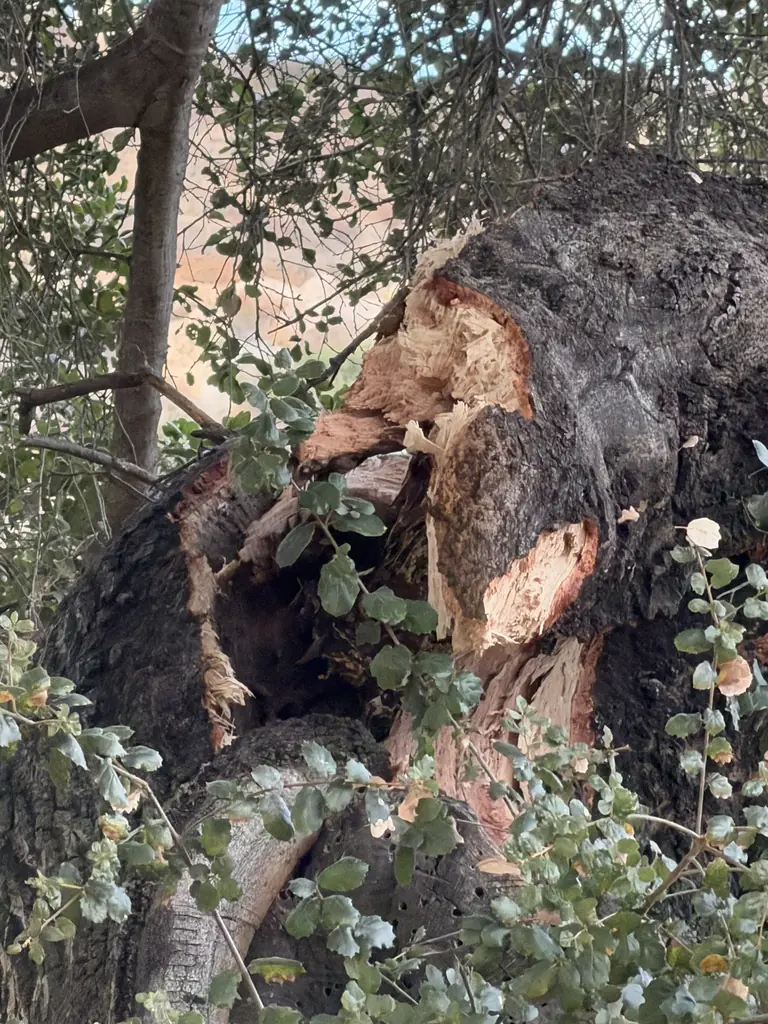
Table of Contents
The Oak Mortality Crisis in East County San Diego
I have worked oaks in Alpine, Descanso, Pine Valley, and Potrero for more than 40 years. The change over that time is plain to anyone who drives Highway 79 or Old Highway 80: more brown crowns, more standing dead trees, more fire fuel.
Two native oaks carry most of the story. Coast Live Oak (Quercus agrifolia) is the broad, dark-leaved evergreen that shades yards and canyon bottoms across the county. California Black Oak (Quercus kelloggii) is the deciduous oak of the higher elevations, with big lobed leaves that turn gold in fall. Both grow in the wildland-urban interface that borders the Cleveland National Forest.
Why Oaks Are Heritage Assets
An oak is not landscaping. A mature Coast Live Oak cools a house, holds a slope, feeds wildlife, and often predates the house itself. Losing one changes the microclimate of a lot, and it changes what the property looks like and feels like for decades. That is why I treat an oak diagnosis differently from a routine trim. Once a tree is gone, it is gone.
Phytopathology: Understanding the Goldspotted Oak Borer
The pest behind much of this mortality is the Goldspotted Oak Borer, or GSOB. It is a small, flatheaded wood-boring beetle in the genus Agrilus. Its scientific name is Agrilus auroguttatus.
How It Got Here
GSOB is not native to San Diego County. Researchers trace it to southeastern Arizona, and the leading explanation for its arrival is people moving infested oak firewood. It was first recognized in San Diego County’s backcountry in the Descanso area. That history is the reason for the firewood rules later in this guide.
How the Larvae Kill a Tree
Adults are only about a quarter inch long. The damage comes from the larvae. They hatch under the bark and tunnel through the inner bark, feeding on the phloem and the cambium and scoring the outer sapwood. Phloem carries sugars from the leaves to the roots. When larvae cut enough galleries around the trunk, they girdle it. The tree cannot move food, the crown starves, and a healthy-looking oak can be dead within a few years of the first attack.
The Diagnostic Checklist: 4 Telltale Symptoms of Active GSOB
I walk the whole tree when I diagnose an oak, from root flare to crown. These four signs are the ones I look for first.
- D-shaped emergence holes. Adult beetles chew out through the bark, leaving a hole roughly 3 to 4 mm across shaped like a capital D, flat on one side. Fresh holes have crisp, sharp edges. They are small enough that you need to look closely, especially on rough bark.
- Bark staining and sap weeping. Dark, wet-looking stains on the lower trunk, sometimes running down the bark, mark spots where larvae are working under the surface. Check the first several feet above the ground.
- Subcortical larval galleries. Peel a patch of bark from an affected area and you find winding, frass-packed tunnels in the cambium zone. This is the confirmation, and it is the one that tells me larvae are actively feeding.
- Progressive crown dieback. The upper canopy thins, twigs die back, and leaves turn brown starting at the top. Lower on the trunk, you often see water sprouts as the tree tries to compensate.
Several of these signs overlap with other oak problems, including drought stress and root disease. That is why a hand-lens look at the bark and a probe of the trunk matter more than a drive-by guess.
The “Tree Doctor” Decision Matrix: Save It or Fell It
This is the call that matters most, and I try to make it honestly.
When an Oak Is Worth Treating
My field rule is to take a hard look at treatment when a tree still has a fairly full crown, meaning less than about 30 to 40 percent dieback. Treatment is not a single product. It is a plan:
- Systemic insecticide treatment applied by a licensed applicator.
- Preventative trunk barrier sprays to protect neighboring healthy oaks.
- Cultural root care, including mulch, careful watering practice, and keeping soil disturbance and compaction off the root zone.
Treatment slows or stops the beetle, and it does not regrow tissue that is already dead. Products, timing, and label rules change, so I confirm current guidance through UC IPM and the county agricultural commissioner before I recommend any application. The earlier we catch a tree, the better the odds.
Irreversible Failure Points
Some oaks are past saving. I stop recommending treatment when I see:
- Severe cambial girdling, with galleries around more than about half of the trunk circumference.
- Secondary root pathogens such as Armillaria mellea, oak root fungus, which attacks stressed oaks and rots the root system that anchors them.
- A crown that is mostly dead.
The Urgency of Felling
A standing dead oak does not wait politely. Dry, dead oak wood loses its elasticity and turns brittle. Limbs that once flexed in the wind snap and drop. The longer a dead oak stands, the less predictable it becomes. If it stands over a fence, an access road, a driveway, or a structure, I move it up the list. A dead oak is also dry fuel, which matters on a property in a fire hazard area.
Rigging and Removal of Structurally Compromised Oaks
Taking down a dead oak is not the same as taking down a healthy one. Healthy wood bends and gives you warning. Dead wood does not.
Why Dead Oaks Are Dangerous to Work
Brittle scaffold limbs can snap under rigging tension without any visible warning. A limb that looks sound can fail the moment it takes load. Decay inside the trunk can hide a hollow where the wood is thin. That changes how I climb, how I rig, and how much load I put on any single piece.
How We Do It
- Controlled sectional lowering. We take the tree down in small, manageable pieces and lower each one on rigging rather than letting it fall.
- Crane or bucket truck access where the tree’s condition makes direct climbing a bad idea.
- Felling wedges and directional cuts to steer a section clear of boundary fences, outbuildings, and neighboring property.
- A defined drop zone, cleared before cutting starts.
On tight East County lots with steep grades and a fence a few feet away, the plan is the job. We assess it in person before we quote it. Our tree removal crews handle these takedowns. If a limb has already split or a tree has come down in a storm, our emergency tree service page is the place to start.
Firewood Quarantine and Debris Management
The same wood that carries GSOB can carry it somewhere else. Never move infested oak firewood out of the area where the tree stood. Larvae can survive in cut wood, and a load of oak firewood is exactly how this beetle reached San Diego in the first place.
What I Recommend
- Keep it local. Leave oak wood from affected trees on the property, or dispose of it locally. Never haul it to a campsite or another county.
- Chip it. Chipping oak debris into small pieces destroys the habitat larvae need.
- Solarize if you keep it. Stacked wood covered with clear plastic and left in full sun can heat enough to help kill larvae.
- Do not trust seasoning alone. Simply letting oak wood dry is not a reliable kill.
Handling rules and treatment details change, and the details differ by site. Check with the county agricultural commissioner or UC IPM for current guidance before you move or burn any oak wood from a suspect tree. Our crews confirm cleanup and wood handling in the estimate, so there are no surprises.
Verified Customer Proof: Field Success in East County
Jon Bielar’s Google review describes the combination of work this guide covers:
“Thorough, safe, responsive and reasonably priced. Took down some dead oak trees that had the potential of smashing my fence. Completed with out incedent. Reasonable price on beetle treatment as well.” — Jon Bielar
You can read the original on Google through the review card on this page. Dead oaks near a fence, a careful takedown, and beetle treatment for what was still alive is the realistic mix on many East County properties.
Barbara Locci in Potrero called us back after a major oak limb failed:
“Bob helped me a couple of years ago by cutting down a dead oak tree. I just called him again because one of my oak trees had a major branch break and fall. He is a pro, shows up, assesses the situation, listens to my concerns, answers questions, then takes care of business.” — Barbara Locci, Google review
Her experience matches how I work: a dead oak taken down first, then a second call when a limb on another oak broke.
Next Steps
Where you start depends on what your oak is showing you.
- Declining or suspect oak: Book an on-site diagnostic evaluation through our ISA Certified Arborist service. I look at the trunk, the crown, and the root zone and give you a straight answer.
- Dead or brittle oak near a structure: Our tree removal service handles safe takedowns of hazard oaks.
- Split limb or storm breakage: Call for emergency tree service.
A free on-site estimate lets me recommend a clear scope for your trees.
Local East County Service
Need Professional ISA Certified Arborist?
Don't leave hazardous limbs, diseased trees, or overgrown canopies to chance. Bob Wining personally assesses your trees on site and provides straightforward, biology-backed recommendations.