
East County Defensible Space & Fire Abatement Guide: PRC 4291 & 30-Day Notice Compliance
An arborist field guide to California PRC 4291 defensible space zones, fuel ladder reduction, and resolving 30-day municipal fire abatement notices in East County.
CSLB D-49 License #1077695 • 40+ Years East County Tree Specialist
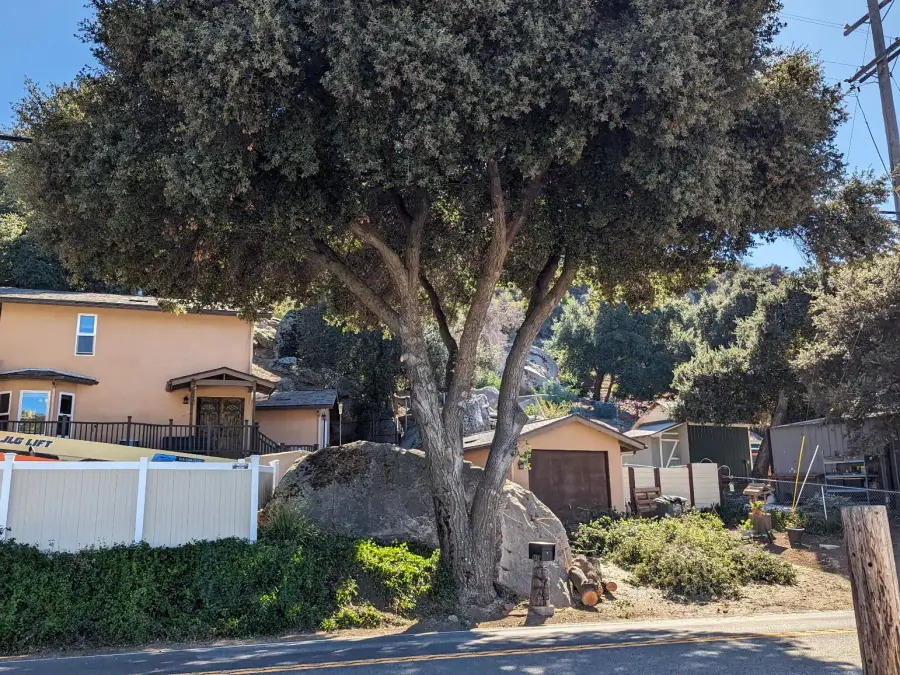
Table of Contents
The Wildland-Urban Interface in East County San Diego
In East County San Diego, living in the Wildland-Urban Interface (WUI) defines rural property ownership. From the granite hillsides of Alpine and Jamul to the ridges of Ramona, Descanso, and Campo, homes border dense chaparral and the Cleveland National Forest: chamise (Adenostoma fasciculatum), redshank, manzanita, scrub oak, and annual grasses.
During autumn Santa Ana winds, high pressure over the Great Basin drives dry air through mountain canyons. Humidity drops into single digits, and gusts exceed 50 to 70 mph. Under these conditions, an ignition along a highway or ridgeline can advance miles in minutes.
Many owners assume defensible space means scraping acreage to bare dirt. In East County, scraping bare destabilizes hillsides, causes erosion, and invites invasive weeds that cure into fine fuels.
Defensible space is about intentional fuel modification. The goal is to force an advancing wildfire out of tree crowns and down to the ground. In sparse surface fuels, flame lengths collapse from thirty feet to under two feet, giving firefighters a survivable perimeter to defend your home.
California Statutory Authority: Understanding PRC 4291
Defensible space is a statutory obligation under California Public Resources Code (PRC) 4291. The law requires anyone owning, leasing, or controlling an occupied building in mountainous or brush-covered lands to maintain 100 feet of defensible space around all structures (or to the property line, whichever is closer).
In East County, compliance is enforced through field inspections by Cal Fire (San Diego County Unit) and regional districts: the San Diego County Fire Protection District, Alpine Fire Protection District, and Lakeside Fire Protection District.
30-Day Notices and Local Fire Enforcement
When inspectors find unbroken brush, tree limbs touching roofs, or continuous fuel ladders, they issue a formal written 30-Day Notice to Abate Fire Hazard.
Receiving a 30-day notice starts a strict timeline:
- The 30-Day Window: You have 30 calendar days to complete cited fuel reduction.
- Re-Inspection: Inspectors return to confirm compliance with fire codes.
- Citations & Fines: If violations remain, the district issues citations and daily fines.
- Forced County Abatement: If an owner fails to comply, the county hires a contractor to clear the hazard and attaches the cost as a tax lien.
Over 40 years in East County, I have helped many property owners resolve these notices quickly with commercial machinery before penalties hit.
The Three Defensible Space Zones: Technical Breakdown
Compliance with PRC 4291 and modern arborist standards divides the 100-foot defensible perimeter around your structures into three concentric management zones.
Zone 0: The 0–5 Foot Ember-Resistant Zone
Zone 0 covers the perimeter from exterior walls outward to 5 feet. Over 90% of structural ignitions are caused by wind-driven embers lodging under eaves, on decks, and in foundation plantings.
Zone 0 requires zero combustible material:
- Roofs and Gutters: Clear all dry pine needles, leaves, and organic duff daily during fire season.
- Inorganic Ground Cover: Replace wood mulch against siding with gravel, river rock, or decomposed granite (DG).
- Combustible Shrubs: Remove flammable bushes beneath windows or eaves to prevent radiant heat from shattering glass.
- Decks and Subfloors: Clear dry leaf litter from underneath elevated decks, and enclose deck perimeters with corrosion-resistant 1/8-inch wire mesh.
Zone 1: The 5–50 Foot Lean, Clean, and Green Zone
Zone 1 extends from 5 feet to 50 feet to eliminate the vertical “Fuel Ladder”:
- Canopy Limbing: Prune branches 6 to 10 feet from the ground (or up to one-third total height on small trees).
- Vertical Clearance Above Shrubs: Maintain vertical separation equal to at least three times shrub height between its top and the lowest overhanging branch.
- 10-Foot Crown Spacing: Maintain 10 feet of horizontal crown spacing (20 to 30 feet on slopes over 20%).
- Structural Clearance: Prune branches within 10 feet of roofs and chimneys; equip chimneys with 1/2-inch wire mesh spark arresters.
- Deadwood Removal: Cut out all dead, broken, or hanging limbs from mature tree crowns.
Zone 2: The 50–100 Foot Reduced Fuel Zone
Zone 2 extends from 50 feet out to 100 feet from structures (or to your property line) to slow advancing fires:
- Annual Grass Mowing: Mow wild grasses to a maximum height of 4 inches before 10:00 AM using string trimmers to avoid rock sparks.
- Shrub Clumping and Mosaic Spacing: Break chaparral into separated islands. Separate shrub clumps by twice shrub height on flat ground, four times on moderate slopes (20% to 40%), and six times on steep slopes over 40%.
- Downed Wood Management: Remove fallen dead tree trunks, rotten logs, and large dead branches that act as fuel sponges for blowing embers.
High-Hazard Specimen Management on Acreage (1 to 5+ Acres)
Managing defensible space on 1 to 5+ acre parcels involves distinct challenges across three key tree groups:
Eucalyptus Stands and Volatile Oils
Blue gum (Eucalyptus globulus) and red gum (Eucalyptus camaldulensis) were widely planted across East County as windbreaks. Today, untended groves represent severe fire hazards. Their foliage contains volatile terpene oils that vaporize under preheating, generating explosive crown fires.
Eucalyptus trees shed dead bark and oily leaf litter continuously. During Santa Ana wind events, burning ribbons of bark travel miles downwind, sparking spot fires. Along driveways, unmaintained limbs suffer sudden branch drop, blocking fire truck access. We manage eucalyptus by clearing shed bark in Zones 1 and 2, elevating branches for 14-foot vertical vehicle clearance, and removing dangerous specimens near buildings.
Native Live Oaks (Quercus agrifolia)
Coast Live Oaks are iconic to East County. Healthy mature oaks are naturally fire-adapted; their thick bark protects the cambium layer from heat.
However, an unmaintained oak choked with dead interior wood and surrounded by dense chaparral undergrowth is easily compromised. We protect oaks by pruning deadwood to branch collars, lifting low limbs, and clearing dry brush from beneath the canopy drip line. We never scrape or trench inside an oak’s root protection zone, and we avoid lion-tailing (stripping inner foliage), which exposes sensitive bark to sunscald and boring beetles.
Palm Trees and Aerial Fire Torches
Untrimmed palms—especially Mexican Fan Palms (Washingtonia robusta) and Queen Palms (Syagrus romanzoffiana)—are severe fire hazards. As fronds die, they accumulate against the trunk to form a dense, fibrous “skirt.”
In a wildfire, embers ignite these dry skirts instantly, creating an aerial torch that showers firebrands onto roofs and brush. For removal and skinning protocols, review our East County Palm Tree Removal & Hazard Field Guide. Dead palms must be removed, and live palms trimmed and skinned before fire season.
Biomass Disposal: Commercial Chipping vs. Mulch Management
Clearing brush and pruning trees on multi-acre properties produces massive volumes of green waste. An average 2-acre clearing job often yields between 15 and 40 tons of raw woody biomass. How you manage this material determines whether your acreage passes inspection or creates an accidental ground-fire hazard.
The Hidden Danger of Over-Mulching
Piling wood mulch 6 to 12 inches deep near buildings creates an unintended smoldering fuel bed. In our arid climate, thick mulch layers dry into punk wood. Windblown embers burrow deep and smolder undetected for days until dry gusts fan them into open flame against your home.
Under arborist and fire code standards:
- Zone 0 (0–5 feet): Zero wood mulch. Use mineral rock or bare soil only.
- Zone 1 (5–50 feet): Organic mulch depth must not exceed 2 inches, kept in isolated beds with bare mineral breaks.
- Zone 2 (50–100 feet): Wood chips may be spread to suppress weed growth, but layer depth must not exceed 3 inches.
High-Volume Commercial Chipping and Zone 2 Spreading
Our crews run heavy-duty commercial brush chippers capable of processing whole tree limbs and dense chaparral up to 12 inches in diameter. We convert large brush piles into coarse, uniform wood chips directly on-site.
These chips are either hauled off to regional recycling centers or spread thinly across flat areas in Zone 2 to stabilize topsoil against erosion. Spreading chips in a thin, compacted layer eliminates air pockets that sustain smoldering fires while keeping your acreage fully compliant with municipal fire codes.
Verified Customer Proof: Real-World East County Compliance
When property owners receive a formal 30-day abatement notice from local inspectors, they need reliable crews with the right equipment to get the job done quickly. We provide the heavy machinery, arboricultural expertise, and crew capacity needed to bring multi-acre properties into full compliance before deadlines arrive.
Here is what local East County residents say about our fire abatement and tree clearing work:
“Bob helped clear brush on a 3 acre property my parents own who had 30 days to clear via notice given by the city. Arrived early, very professional, impeccable work, and done swiftly!” — Ivana, Multi-Acre Municipal 30-Day Notice Abatement
“Bob was very helpful with fire mitigation around the house and topping many of our trees… Prompt, thorough, and all at a great price.” — Bruno, Multi-Acre Wildfire Mitigation & Canopy Management
“Bob and his team are outstanding at tree maintenance and arborist work. They are extremely clean, professional, and know exactly how and what to trim back, especially for fire abatement in East County areas.” — Matt Mac, East County Fire Abatement & Precision Arborist Pruning
Every review featured on our website represents verified work completed in East County San Diego. When we finish an abatement job, our clients pass their fire marshal re-inspections cleanly.
Emergency Readiness & Service Action Links
Defensible space work must be completed before Santa Ana conditions arrive in late summer and fall. Waiting until smoke appears on the ridge is too late.
If you need to evaluate your property or resolve an active inspection notice, contact us for professional arborist services:
- Facing a 30-Day Municipal Notice or Need Fuel Breaks Cleared: Arrange prompt clearing through our fire abatement and brush clearing services. We eliminate fuel ladders, complete Zone 0–2 requirements, and chip heavy chaparral on 1- to 5+ acre parcels.
- Dead Oak Snags, Beetle-Killed Pines, or Hazardous Trees: If you have standing dead trees that could fall during high winds or ignite during a fire, view our hazardous tree removal services.
- Dense Canopies Needing Wind Thinning and Crown Lifting: For mature oaks and eucalyptus requiring crown balance, structural thinning, or roof clearance, visit our tree trimming and pruning services.
Protecting your rural home starts with an on-site evaluation. Call Bob Wining directly to walk your property, inspect your tree canopies, and establish a defensible space perimeter that safeguards your home and family.
Local East County Service
Need Professional Fire Abatement & Brush Clearing?
Don't leave hazardous limbs, diseased trees, or overgrown canopies to chance. Bob Wining personally assesses your trees on site and provides straightforward, biology-backed recommendations.